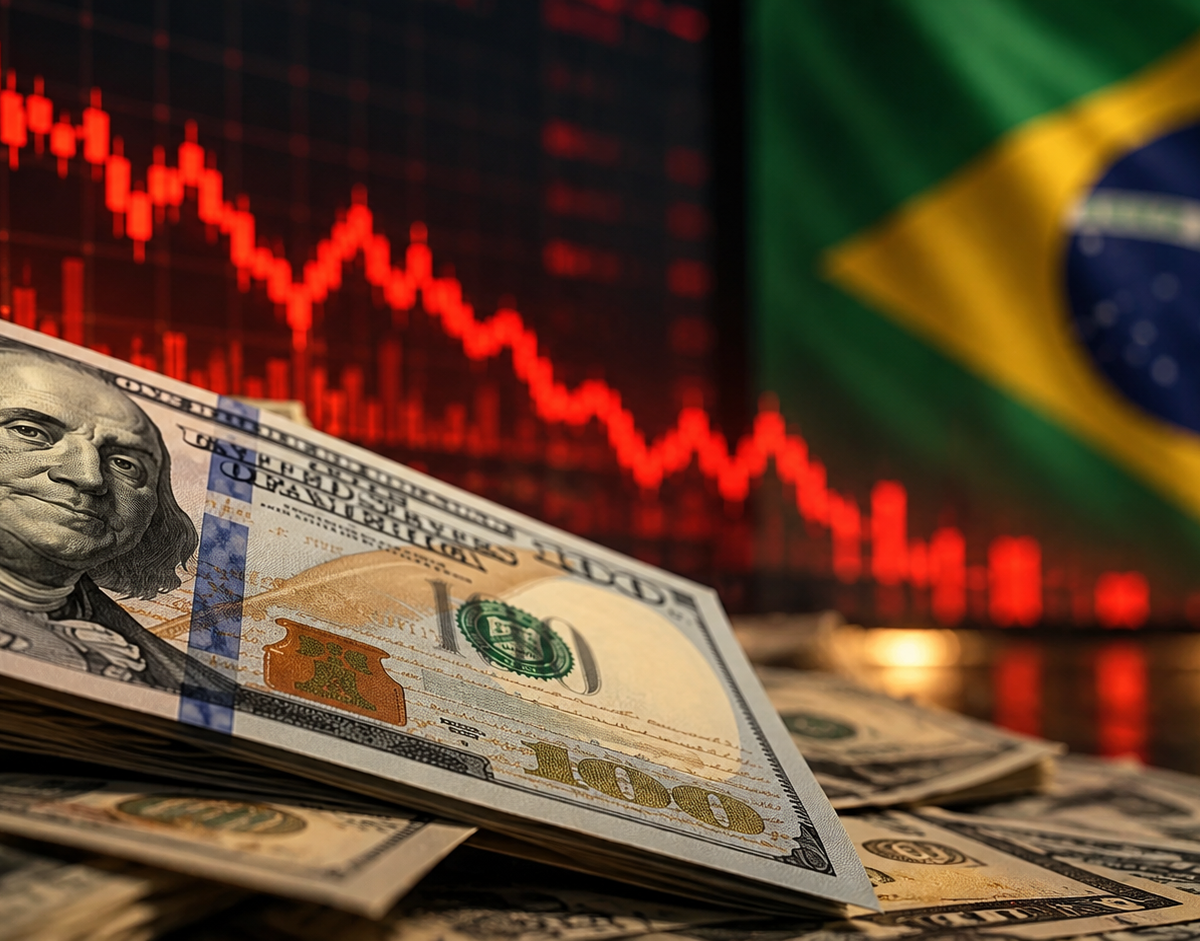
On Monday (Oct. 26), the first trading session after the runoff that re-elected President Luiz Inácio Lula da Silva of the Workers' Party (PT), the U.S. dollar closed up 8.21% at R$5.403 against Brazil's real, and the Ibovespa, the country's main stock index, fell 13.88% to 176,608 points. Right after the open, the index's drop exceeded 10% and triggered the circuit breaker, a mechanism at B3, Brazil's stock exchange, that halts trading for 30 minutes during extreme stress. The last time that happened was in March 2020, at the start of the Covid-19 pandemic.
According to analyses compiled by Agência Brasil, CNN Brasil and Poder360, some investors had built positions betting on a win by Flávio Bolsonaro of the Liberal Party (PL), whom the market associated with a faster fiscal adjustment. After the result, those bets were unwound and investors sought protection. During the morning, the dollar rose above R$5.60 and the Ibovespa was down about 17%. Trading volume on the exchange reached R$88.6 billion, more than three times the recent daily average of about R$25 billion, according to Agência Brasil.
The move also hit interest-rate futures, contracts traded on B3 that show how much the market expects to pay to borrow money over different periods. Rates jumped more than 250 basis points (2.5 percentage points) across several maturities, and some contracts hit their daily trading limits. To contain the pressure, Brazil's National Treasury carried out extraordinary buybacks of government bonds. According to Poder360, Monday's buybacks alone came to about R$7.1 billion in fixed-rate bonds.
What changes for businesses
The most immediate effect is on the exchange rate. Companies that import inputs, goods or services priced in dollars, such as software, ad platforms and equipment, now face a pricier dollar than the week before, when it closed near R$4.99. Exporters, on the other hand, receive more reais for each dollar sold. Even after the jump, the dollar is still down 1.57% against the real in 2026, according to Agência Brasil, meaning the current level has erased only part of the real's gains this year.
The second channel is credit. Interest-rate futures are the benchmark for fixed-rate loans, working capital, financing and corporate debt issues such as debentures. Higher rates tend to make new borrowing more expensive while volatility lasts, even though the Selic, set by the central bank's monetary policy committee (Copom), remains at 13.75% a year. On the stock market, losses in market value reached R$734 billion on the day, according to a survey by Elos Ayta cited by InfoMoney, which typically leads companies to revisit plans for IPOs and new share offerings.
On the government side, Finance Minister Dario Durigan told Broadcast, according to Poder360, that the government intends to change the law or the Constitution this year to target the midpoint of the fiscal goal, and said, according to InfoMoney, that measures are ready to send a signal to the market. On Tuesday (Oct. 27), there was a partial correction: the dollar fell 0.97% to R$5.350 and interest-rate futures declined across the curve, but the Ibovespa slipped another 0.51% to 175,710 points. The same day, according to CNN Brasil and InfoMoney, Citigroup and BCA Research downgraded their recommendations on Brazilian assets.
“There are fiscal measures ready”
— Dario Durigan, Brazil's finance minister, according to InfoMoney (translated from Portuguese)
What to watch next
- Details of the fiscal measures announced by the Finance Ministry and how they move through Congress.
- The next Copom meeting, scheduled for Nov. 4, with the Selic at 13.75%.
- Further Treasury bond buybacks and the behavior of interest-rate futures.
- The dollar's level in the coming weeks, which sets the cost of imports and foreign-currency contracts for year-end.